


Pre-Training Data Is What Decides If Your Model Generalizes
Reading time /
7 min
Data & AI
.png)
TL;DR
- The architecture of a foundation model is the exciting part. The data is what decides whether it generalizes.
- Scale without diversity is the bigger blind spot. A model pre-trained on narrow data learns one distribution's quirks with more confidence.
- The diversity gap that weakens pre-training is the same one that stalls a device at FDA clearance.
- Diversity only helps if you can pool it. Inspecting, filtering, and training across the whole corpus is a centralized capability.
Introduction
Most of the energy in medical-imaging AI right now goes into the model. Bigger backbones, cleverer objectives, more parameters. That is the fun part. But it is not the part that decides whether the thing works when it leaves your building.
Generalization is a property of the pre-training data, not the architecture. Whether a model holds up on scanners, protocols, and populations it never saw comes down to what it was trained on. Pre-training is a data problem. And so is everything after it.
Pre-training, fine-tuning, and validation are three different asks
Pre-training teaches a model general representations from a large, broad corpus, before it has any specific task. The goal is breadth. The model learns what anatomy, noise, and vendor rendering look like across the widest range you can give it.
Fine-tuning adapts that pre-trained model to your specific task, using a smaller labeled set. The goal is precision on a narrow objective. Fine-tuning cannot recover variation the model never saw during pre-training.
Validation measures whether the result holds on data the model was never trained on. The goal is evidence. For regulatory purposes, that means multi-site, independent, diverse and representative of the intended use population.
Three stages, three goals, one shared dependency. All of them fail the same way when the underlying data is narrow.
Scale is necessary, but diversity is what generalizes
The premise of a foundation model is straightforward. Pre-training on a large, broad corpus teaches representations general enough to transfer to many tasks. That premise has a load-bearing word: broad.
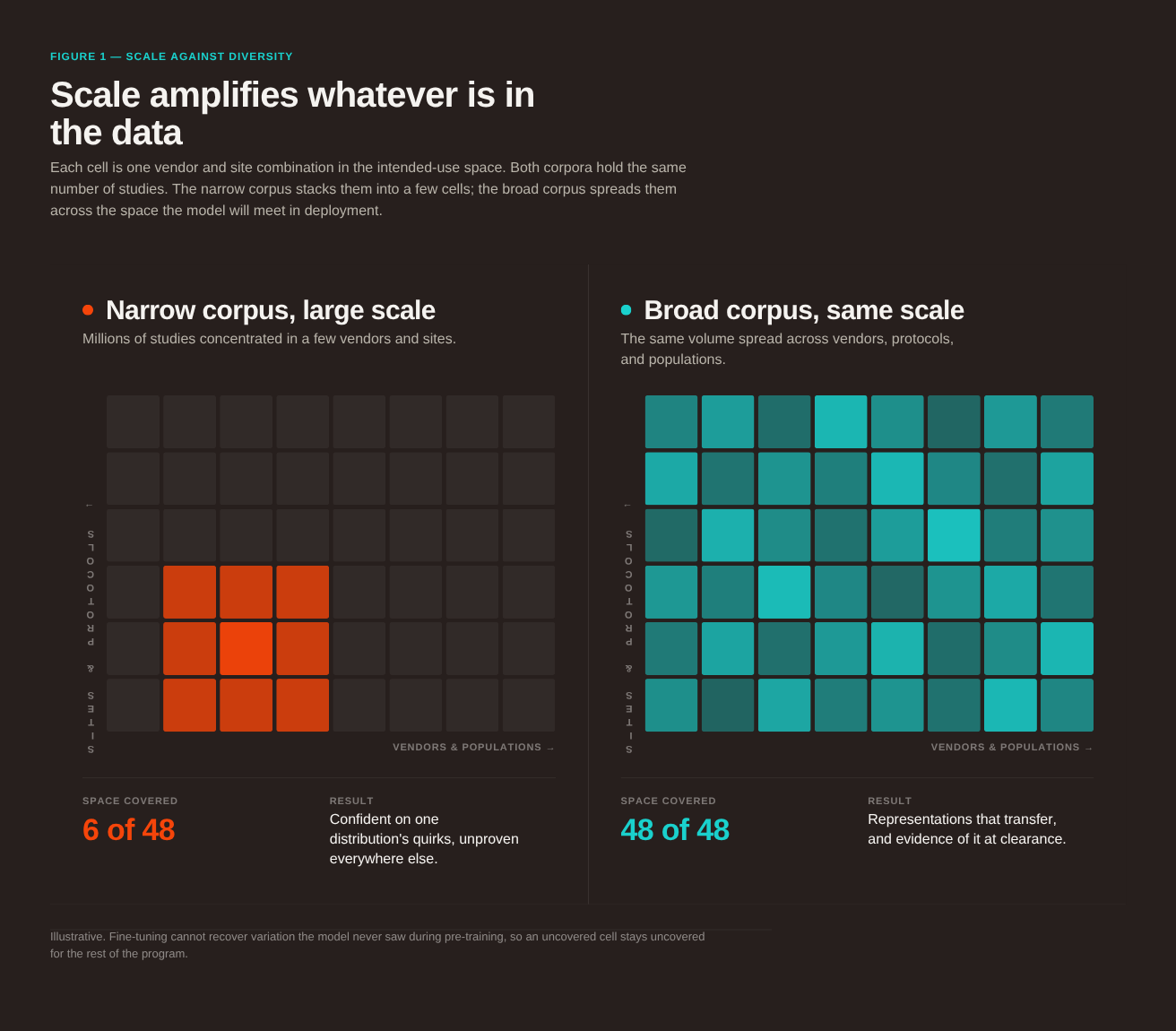
Feed a large model enormous but narrow data and you do not get generalization. One region, a handful of vendors, a skewed population. What you get is a bigger, more confident version of the same blind spots.
The model still learns the Siemens rendering, the single-site protocol, the demographic skew. Those still predict the label. Scale amplifies whatever is in the data. If the data is narrow, scale amplifies the narrowness.
Evidence snapshot
The diversity that makes a model generalize during pre-training is the same diversity a regulator asks about at clearance. Representativeness across the intended population, multi-site independent test data, and evidence the model was not overfit to where it was trained.
It is the same problem at both ends of the lifecycle
Teams tend to treat these as separate purchases. Volume for pre-training from one vendor. A validation set from another. Then months spent reconciling provenance for the FDA.
But it is one requirement wearing different hats. Buy for it once, from one source, and the whole program gets simpler.
.png)
Diversity only counts if you can pool it
Here is the practical catch. Variation is only useful if you can assemble it, inspect it, filter it, and actually train or validate across it.
Federated approaches keep data at each source and move the model to the silo. That is elegant for privacy but challenging for generalization. You can never see or learn across the whole distribution at once.
A centralized corpus is a genuinely different capability. You can pool full anatomy, curate by modality and vendor, and validate against the full range of variation. It stays privacy-preserving when the data is de-identified before it ever moves.
How Segmed fits
One data network should carry you from the first stage to the FDA. Full anatomy and multi-vendor breadth to pre-train. Targeted volume to fine-tune the gaps. Multi-site, representative sets to validate. Documented, defensibly de-identified data to clear. Fresh data to monitor.
Segmed was built imaging-first to be exactly that. Millions of studies across 31 million patients, multi-vendor and multi-site. Centralized, so you can pool and train across all of it. De-identified under both HIPAA methods. Curatable by Segmed Clinical Team down to modality, body part, geography, and demographics.
If your model will not generalize, do not reach for a bigger backbone first. Find out what your training data never saw. The answer matters just as much the day you file with the FDA.
See what's available for your modality >
Frequently Asked Questions – F.A.Q.
What is the difference between pre-training and fine-tuning?
Pre-training teaches a model general representations from a large, broad corpus before any specific task. Fine-tuning adapts that model to one task using a smaller labeled set. Fine-tuning cannot recover diversity missing from pre-training.
Does more pre-training data always improve generalization?
No. More of the same distribution mostly reinforces existing blind spots. Gains come from added variety across vendors, protocols, sites, and populations. Raw count is not the driver.
Why does centralized data matter for pre-training specifically?
Because you can pool and train across the whole corpus consistently. Federated setups turn that into a coordination problem rather than a data one.
Is pre-training data different from validation data?
They serve different stages, but the underlying requirement is the same. Diversity and documentation. That is why one network can supply both.
How do I know what is actually in the data?
Curate by modality on Openda and request a sample before committing. What matters is the inventory, not a headline total.
Related resources
Unlock the power of real-world imaging data through our proprietary, self-service platform, Openda