


AI Medical Devices: FDA Regulatory Requirements and Pathways

Reading time /
Regulatory

TL;DR
• The FDA reports more than 1,600 authorized AI-enabled medical devices as of September 2026.
• Radiology accounts for 76.5% of AI/ML-enabled device authorizations through 2025.
• FDA's draft AI guidance asks sponsors to document data sources, reference standards, representativeness, and test data independence.
• A Predetermined Change Control Plan (PCCP) lets manufacturers implement pre-authorized model updates without a new submission for each change.
Introduction
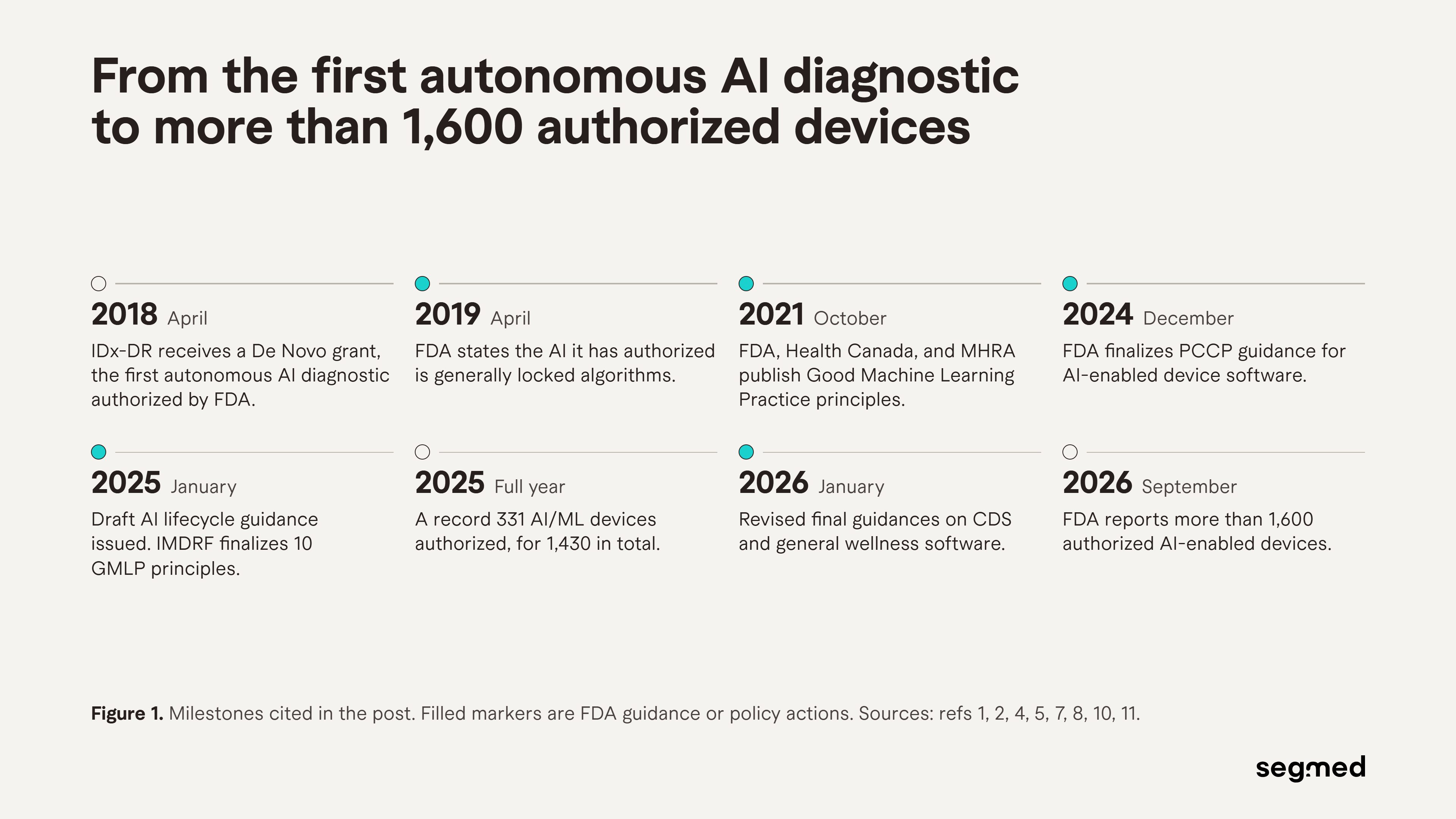
The FDA has authorized more than 1,600 AI-enabled medical devices for market in the United States as of September 2026.1 Radiology applications account for the largest share.3 That number continues to grow, with a record 331 AI/ML-enabled devices authorized in 2025.2 Manufacturers keep submitting new algorithms for diagnostic imaging, cardiology, neurology, and other clinical specialties.
For teams developing AI medical devices, the regulatory pathway determines everything from submission requirements to data documentation standards. This guide covers how the FDA defines and classifies AI software and the three main routes to market authorization. It also covers dataset requirements for submissions and the practical challenges of building algorithms that perform reliably after deployment.
What are AI-enabled medical devices under FDA definition
The FDA does not regulate AI as such. It regulates medical devices, including AI-enabled medical devices.1 Under the FD&C Act, a device is intended to diagnose, cure, mitigate, treat, or prevent disease. It can also be intended to affect the structure or function of the body.1
FDA's draft AI guidance describes an AI-enabled device as one that includes one or more AI-enabled device software functions (AI-DSFs). An AI-DSF uses one or more AI models to achieve its intended purpose.4 The key question is not whether software uses AI, but whether it is intended for a medical purpose.
Here's what that means in practice: if software is marketed to diagnose, treat, cure, mitigate, or prevent disease, it likely qualifies as a medical device. A chest X-ray algorithm that flags potential pneumonia? That's a medical device. An app that tracks your daily steps? Probably not.
However, not all healthcare AI falls under FDA oversight. Section 520(o) of the FD&C Act excludes certain software functions from the device definition.1 FDA published revised final guidances on clinical decision support (CDS) and general wellness software on January 6, 2026.7 To be excluded as non-device CDS, software must not acquire, process, or analyze medical images or signals.7 The intended use, as stated in marketing materials and labeling, determines whether FDA regulation applies.
Evidence snapshot
Under FDA's 2026 CDS guidance, software that analyzes medical images cannot qualify for the non-device CDS exclusion.7 For imaging AI developers, the device framework is the starting point.
How the FDA classifies AI software as a medical device
Device software functions fall into two main categories: Software as a Medical Device (SaMD) and Software in a Medical Device (SiMD).4
1. Software as a Medical Device (SaMD)
SaMD refers to software that performs medical functions on its own, without being part of a hardware device. Think of a diagnostic algorithm that runs on a hospital's existing computers, or a smartphone app that analyzes photographs of skin lesions for melanoma risk. The software itself is the medical device.
2. Software in a Medical Device (SiMD)
SiMD describes software embedded within hardware. Deep learning image reconstruction built into an imaging system is one example. The software is part of a larger device system.
3. Locked versus adaptive algorithms
This distinction carries significant regulatory weight. Locked algorithms produce the same output given the same input, every time. Once validated, their behavior stays predictable.8
Adaptive algorithms, sometimes called continuously learning algorithms, can update their behavior based on new data after deployment. In 2019, the FDA stated that the AI technologies it had authorized were generally locked algorithms.8 For models that update automatically or continuously, FDA encourages early discussion through the Q-Submission Program.4 Planned model changes can be pre-authorized through a PCCP, covered below.5
FDA regulatory pathways for AI medical devices
Three main pathways exist for bringing AI medical devices to market. The right pathway depends on device risk and whether a suitable predicate device exists. Of 1,430 AI/ML-enabled devices authorized through 2025, 96.2% used the 510(k) pathway.2
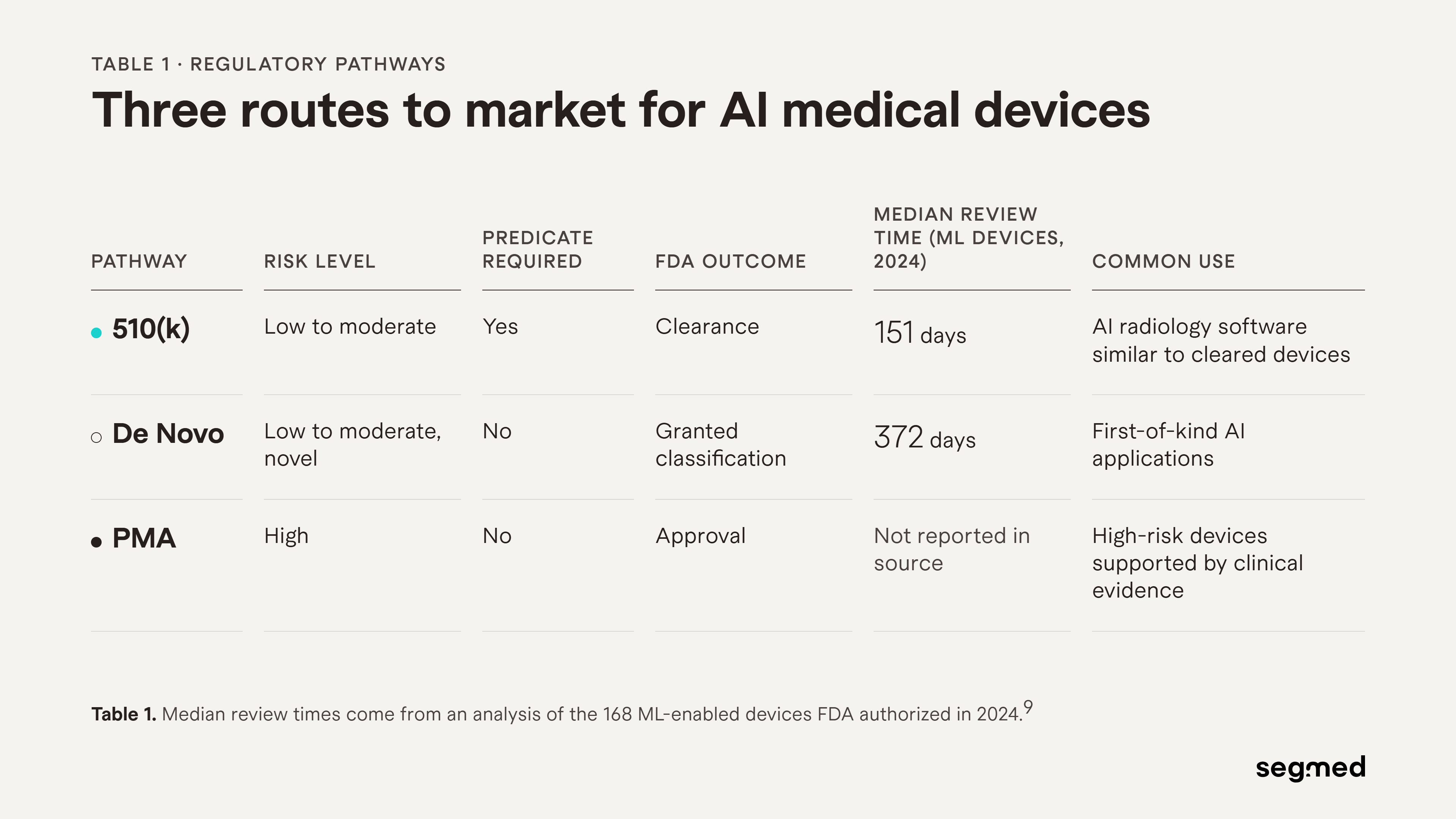
Median review times come from an analysis of the 168 ML-enabled devices FDA authorized in 2024.9
1. 510(k) clearance
The 510(k) pathway works when a device is substantially equivalent to a legally marketed predicate device. Most AI radiology software reaches the market this way. The submission demonstrates that the new device shares the same intended use and similar technological characteristics as the predicate. Alternatively, it shows that any differences do not raise new safety or effectiveness questions.
2. De Novo classification
When no predicate exists but the device presents low-to-moderate risk, the De Novo pathway provides a route to market. This pathway establishes a new device classification and creates a predicate for future similar devices. Several first-of-kind AI diagnostic tools have used De Novo classification to reach patients. IDx-DR, the first autonomous AI-based diagnostic system authorized by the FDA, received a De Novo grant in 2018.10
3. Premarket Approval (PMA)
PMA is the most rigorous pathway, reserved for high-risk devices. It generally requires clinical evidence demonstrating safety and effectiveness. PMA is uncommon for AI devices, since the remaining 3.8% of AI/ML-enabled authorizations were split across De Novo, PMA, and other routes.2
Data requirements for FDA AI/ML submissions
The FDA expects thorough documentation of the data used to develop and test AI algorithms. For an AI-enabled device, FDA considers the model part of the mechanism of action. That is why its draft guidance calls clear data management documentation critical.4
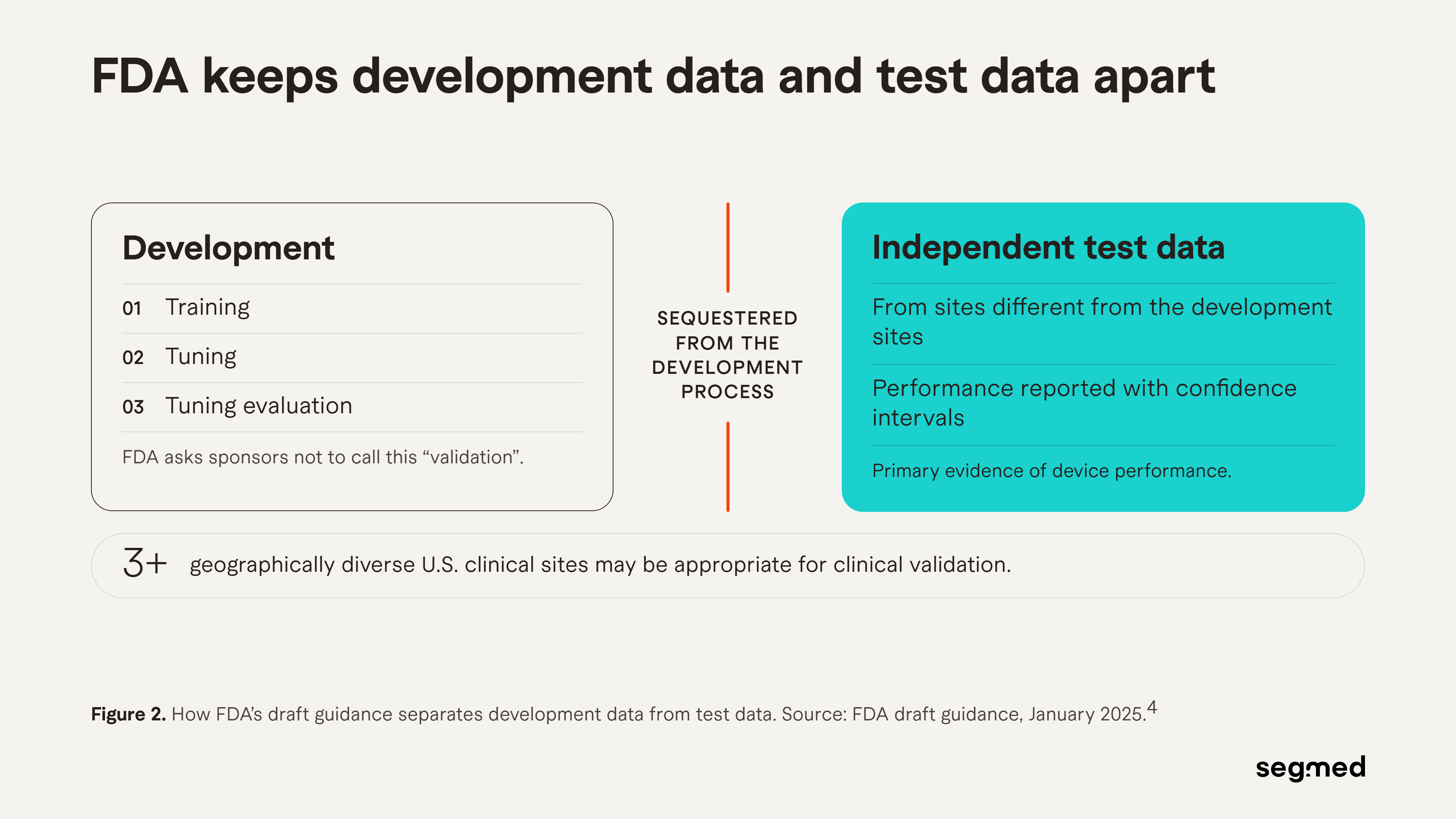
Terminology tip: In submissions, FDA uses "validation" to mean confirming a device meets its intended use. It asks sponsors not to use "validation" for model tuning. FDA groups training, tuning, and tuning evaluation under the term "development."4
Training data
Training data is the dataset used to develop the algorithm's parameters. FDA's draft guidance asks for data sources, clinical sites, collection time period, dataset size, and quality assurance processes.4 It also asks how the reference standard, or ground truth, was established. Where did the images come from? Who labeled them? How were disagreements resolved?
Tuning and tuning evaluation data
Tuning data supports hyperparameter optimization and model selection. Sponsors should describe how development data were split and which activities used each subset.4 Keeping these data separate from test data helps reveal overfitting, which occurs when an algorithm performs well on familiar data but poorly on new cases.
Independent test data
The independent test set provides the primary evidence of device performance. FDA recommends sequestering test data from model developers and the development process.4 In general, test data should come from sites different from those used for development.4 Performance metrics such as sensitivity, specificity, and AUROC should be reported with confidence intervals.4
Site and device diversity
FDA expects datasets to reflect real-world variation. An algorithm trained only on images from academic medical centers using one scanner manufacturer may perform differently in community hospitals with different equipment. FDA's draft guidance notes that at least three geographically diverse U.S. clinical sites may be appropriate for clinical validation.4 Key diversity factors include:
• Geographic distribution: data from multiple clinical sites reduces site-specific bias
• Device variability: images from different scanner manufacturers, models, and acquisition protocols
• Demographic representation: patient age, sex, race, ethnicity, and relevant clinical characteristics
• Clinical setting diversity: academic centers, community hospitals, and outpatient facilities
If validation data come from outside the U.S., sponsors should explain how they compare to the U.S. population and medical practice.4
Good Machine Learning Practice principles for medical AI
In October 2021, the FDA, Health Canada, and the UK MHRA jointly published Good Machine Learning Practice (GMLP) guiding principles.11 In January 2025, the International Medical Device Regulators Forum (IMDRF) finalized 10 GMLP guiding principles that build on that work.11 These principles provide a framework for responsible AI development that aligns with regulatory expectations.
Multidisciplinary expertise
Development teams benefit from including clinical, technical, and regulatory expertise throughout the product lifecycle. Clinicians understand the use environment. Engineers understand model behavior. Regulatory specialists understand documentation requirements. Gaps in any area can surface as submission deficiencies.
Representative datasets
Training and test data that reflect the intended patient population and use environment produce more generalizable algorithms. This principle connects directly to the data diversity requirements described above.
Independent test sets
True independence of test data from all development activities provides valid performance estimates. Data leakage between development and test datasets creates uncertainty about true device performance.4
Human-AI team performance
The FDA considers how clinicians interact with AI outputs, not just standalone algorithm performance. A device that performs well in isolation but confuses clinicians in practice may not achieve its intended benefit. For imaging AI that aids clinical decisions, reader studies with and without the device typically serve as the primary performance evaluation.4
Lifecycle performance monitoring
Deployed AI devices require ongoing monitoring for performance drift or degradation. Changes in patient populations, disease patterns, or input data can affect algorithm accuracy over time, even for locked algorithms.4
Predetermined Change Control Plans for AI-enabled devices
Predetermined Change Control Plans (PCCPs) address a fundamental challenge: how can algorithms improve over time without requiring new regulatory submissions for each update? FDA finalized its PCCP guidance for AI-enabled device software functions in December 2024.5
A PCCP describes, in advance, the modifications a manufacturer plans to make. It also sets out the methodology to develop, validate, and implement those changes, plus an assessment of their impact.5 FDA reviews the PCCP as part of the marketing submission. Modifications made according to an authorized PCCP do not need a separate submission for each change.5
The plan has three core components:
• Description of modifications: the specific planned changes the plan covers
• Modification protocol: how changes will be developed, validated, and implemented
• Impact assessment: an assessment of the impact of the planned modifications
FDA-authorized AI medical devices by clinical specialty
The FDA maintains a public list of AI-enabled devices that have received marketing authorization.1 FDA notes the list is not comprehensive. It identifies devices mainly through AI-related terms in their authorization documents.12 Through 2025, the Radiology, Cardiovascular, and Neurology review panels accounted for 90.6% of authorizations.3
Radiology
Radiology accounts for 76.5% of AI/ML-enabled authorizations through 2025, or 1,094 of 1,430 devices.3 It also remained dominant from 2023 to 2025, at 77.5% of authorizations in that period.2 Applications span chest X-ray interpretation, mammography analysis, brain MRI assessment, musculoskeletal imaging, and more.
Cardiology
The Cardiovascular panel is one of the three most represented panels.3 AI applications in cardiology include ECG analysis for arrhythmia detection, echocardiography interpretation, and cardiac CT and MRI analysis.
Pathology
Pathology remains a small category, with 9 of 1,430 authorizations (0.6%) through 2025.3 Digital pathology AI tools analyze whole slide images for cancer detection and grading.
Ophthalmology
Autonomous AI systems for diabetic retinopathy screening represent a notable category. IDx-DR was the first autonomous AI-based diagnostic system authorized by the FDA.10 It provides a screening decision without clinician interpretation, within a defined patient population and clinical protocol.10
Bias, generalizability, and real-world performance risks
AI devices that perform well in development may underperform in deployment. Understanding these risks helps explain FDA's emphasis on diverse, well-documented datasets.
Demographic bias
Algorithms trained on non-representative populations may perform differently across patient subgroups. A skin lesion classifier trained primarily on lighter skin tones may miss melanomas in patients with darker skin. FDA's draft guidance recommends subgroup analysis by sex, age, race, ethnicity, clinical site, and acquisition equipment.4 Public reporting still lags behind that expectation.
Evidence snapshot
A scoping review of 692 FDA AI/ML device summaries from 1995 to 2023 found only 3.6% reported race or ethnicity.6
Site and scanner drift
Differences between training environments and deployment settings affect accuracy. Imaging protocols, equipment calibration, and clinical workflows vary across sites. FDA warns that models can learn features unique to specific scanners or sites rather than patient anatomy.4 An algorithm validated on images from one scanner manufacturer may require additional validation before deployment on others.
Ground truth variability
The quality of training labels directly affects algorithm reliability. Labels based on radiologist interpretation alone may differ from labels confirmed by pathology or clinical follow-up. FDA asks sponsors to describe how the reference standard was established and the uncertainty inherent in it.4 When clinicians set the reference standard, FDA also asks for intra- and inter-clinician variability.4
Post-market surveillance for AI-enabled medical devices
FDA oversight continues after market authorization. Manufacturers have ongoing obligations to monitor device performance and report problems.
• Medical Device Reporting (MDR): mandatory reporting of deaths, serious injuries, and malfunctions under 21 CFR Part 8034
• Corrections and removals: reporting under 21 CFR Part 8064
• Post-market studies: FDA may require additional data collection as a condition of authorization
• Performance monitoring: a postmarket performance monitoring plan, which FDA's draft guidance recommends4
• Corrective actions: a process for addressing identified safety or performance issues
Real-world performance data increasingly informs both manufacturer improvements and FDA's understanding of how AI devices behave outside controlled study conditions. FDA has requested public comment on measuring and evaluating AI-enabled device performance in the real world.1
Building regulatory-grade imaging datasets for FDA submissions
Assembling datasets that meet FDA expectations requires attention to sourcing, documentation, and compliance. Gathering diverse, well-documented data is often the most time-consuming part.
Regulatory-grade datasets require HIPAA-compliant de-identification, using either the Safe Harbor or Expert Determination method.13 DICOM metadata integrity matters because FDA expects sponsors to characterize acquisition equipment and imaging protocols.4 Annotation quality depends on expert labeling with documented methodology and, where possible, inter-reader agreement metrics.4
Segmed provides access to regulatory-grade imaging datasets from more than 2,800 healthcare partner sites across 50 U.S. states and 5 continents.14 This geographic and device diversity supports the data requirements FDA expects in AI/ML submissions. More than 50 products have been FDA-cleared using Segmed's data network.14
Connect with us to discuss how diverse, de-identified imaging datasets can support your regulatory submission.
Frequently asked questions - F.A.Q.
How many AI medical devices has the FDA authorized?
The FDA reports more than 1,600 authorized AI-enabled medical devices as of September 2026.1 The agency updates its public list periodically. Radiology remains the largest category.3
Does the FDA regulate ChatGPT or general-purpose LLMs as medical devices?
General-purpose large language models are not regulated as medical devices unless intended for a defined medical purpose. The FDA regulates devices based on intended use, not AI as such.1 An LLM marketed to diagnose conditions or recommend treatments would likely meet the device definition and require FDA authorization.
How long does FDA clearance take for an AI medical device?
Timelines vary based on pathway, device complexity, and submission quality. For ML-enabled devices authorized in 2024, the median review time was 151 days for 510(k) and 372 days for De Novo.9 PMA applications typically require more extensive clinical evidence.
What is the difference between FDA clearance and FDA approval for AI devices?
Clearance refers to the 510(k) pathway. De Novo requests are granted, which creates a new device classification.10 Approval refers specifically to the Premarket Approval (PMA) pathway for high-risk devices.1 The terms have distinct regulatory meanings and are not interchangeable.
Is FDA's AI medical device guidance final?
The PCCP guidance for AI-enabled devices is final, published in December 2024.5 The broader lifecycle guidance was issued as a draft in January 2025. FDA still lists it as a draft as of September 2026.1
Does the FDA use AI tools internally for regulatory review?
Yes. The FDA launched Elsa, a generative AI tool for its employees, on June 2, 2025.15 FDA states that Elsa does not train on input data or on data submitted by regulated industry.16 The agency's core device role remains evaluating AI devices submitted by manufacturers.
References
1. U.S. Food and Drug Administration. Artificial Intelligence-Enabled Medical Devices. Content current as of September 22, 2026. https://www.fda.gov/medical-devices/digital-health-center-excellence/artificial-intelligence-enabled-medical-devices
2. Lee YS, Youn BY. Clinical Specialty Expansion of AI-Enabled and Machine Learning-Enabled Medical Devices Authorized by the US Food and Drug Administration From 1995 to 2025: Longitudinal Content Analysis. J Med Internet Res. 2026;28:e103040. doi:10.2196/103040
3. Three Decades of Food and Drug Administration Authorizations of Artificial Intelligence/Machine Learning-Enabled Medical Devices: Persistent Specialty Concentration and the Care-Delivery Gap (1995-2025). https://pmc.ncbi.nlm.nih.gov/articles/PMC13464356
4. U.S. Food and Drug Administration. Artificial Intelligence-Enabled Device Software Functions: Lifecycle Management and Marketing Submission Recommendations. Draft guidance, issued January 7, 2025. https://www.fda.gov/media/184856/download
5. U.S. Food and Drug Administration. Marketing Submission Recommendations for a Predetermined Change Control Plan for Artificial Intelligence-Enabled Device Software Functions. Final guidance, December 2024. https://www.fda.gov/regulatory-information/search-fda-guidance-documents/marketing-submission-recommendations-predetermined-change-control-plan-artificial-intelligence
6. Muralidharan V, Adewale BA, Huang CJ, Nta MT, Ademiju PO, Pathmarajah P, et al. A scoping review of reporting gaps in FDA-approved AI medical devices. NPJ Digit Med. 2024;7:273. doi:10.1038/s41746-024-01270-x
7. U.S. Food and Drug Administration. Clinical Decision Support Software. Final guidance, January 6, 2026. https://www.fda.gov/media/109618/download
8. U.S. Food and Drug Administration. Statement from FDA Commissioner Scott Gottlieb, M.D. on steps toward a new, tailored review framework for artificial intelligence-based medical devices. April 2, 2019. https://www.fda.gov/NewsEvents/Newsroom/PressAnnouncements/ucm635083.htm
9. Machine Learning-Enabled Medical Devices Authorized by the US Food and Drug Administration in 2024: Regulatory Characteristics, Predicate Lineage, and Transparency Reporting. https://pmc.ncbi.nlm.nih.gov/articles/PMC12730494/
10. IDx. FDA Permits Marketing of IDx-DR for Automated Detection of Diabetic Retinopathy in Primary Care. April 12, 2018. https://www.biospace.com/fda-permits-marketing-of-idx-dr-for-automated-detection-of-diabetic-retinopathy-in-primary-care
11. U.S. Food and Drug Administration. Good Machine Learning Practice for Medical Device Development: Guiding Principles. https://www.fda.gov/medical-devices/artificial-intelligence-enabled-medical-devices/good-machine-learning-practice-medical-device-development-guiding-principles
12. U.S. Food and Drug Administration. List of Artificial Intelligence-Enabled Medical Devices. https://www.fda.gov/medical-devices/artificial-intelligence-enabled-medical-devices/list-artificial-intelligence-enabled-medical-devices
13. U.S. Department of Health and Human Services. HIPAA Privacy Rule de-identification standard, 45 CFR 164.514(b).
14. Segmed. Homepage statistics. Accessed September 25, 2026. https://segmed.ai/
15. U.S. Food and Drug Administration. FDA Launches Agency-Wide AI Tool to Optimize Performance for the American People. June 2, 2025. https://www.fda.gov/news-events/press-announcements/fda-launches-agency-wide-ai-tool-optimize-performance-american-people
16. U.S. Food and Drug Administration. FDA Expands AI Capabilities and Completes Data Platform Consolidation. May 2026. https://www.fda.gov/news-events/press-announcements/fda-expands-ai-capabilities-and-completes-data-platform-consolidation
Related Resources
Real-world validation still matters for imaging AI
Single-center vs multi-center studies: what we've learned about scaling imaging AI
From concept to clinical practice: how Segmed powered RadUnity's fast-track to FDA clearance
Optimizing and accelerating medical device regulatory approvals with AI and RWiD