


AI in Mammography Screening: The MASAI Trial Demonstrates Improved Cancer Detection with Reduced Workload
Reading time /
5 minutes
Research
TL;DR
- The MASAI trial is the largest randomized study to evaluate AI-assisted mammography screening in a real population setting
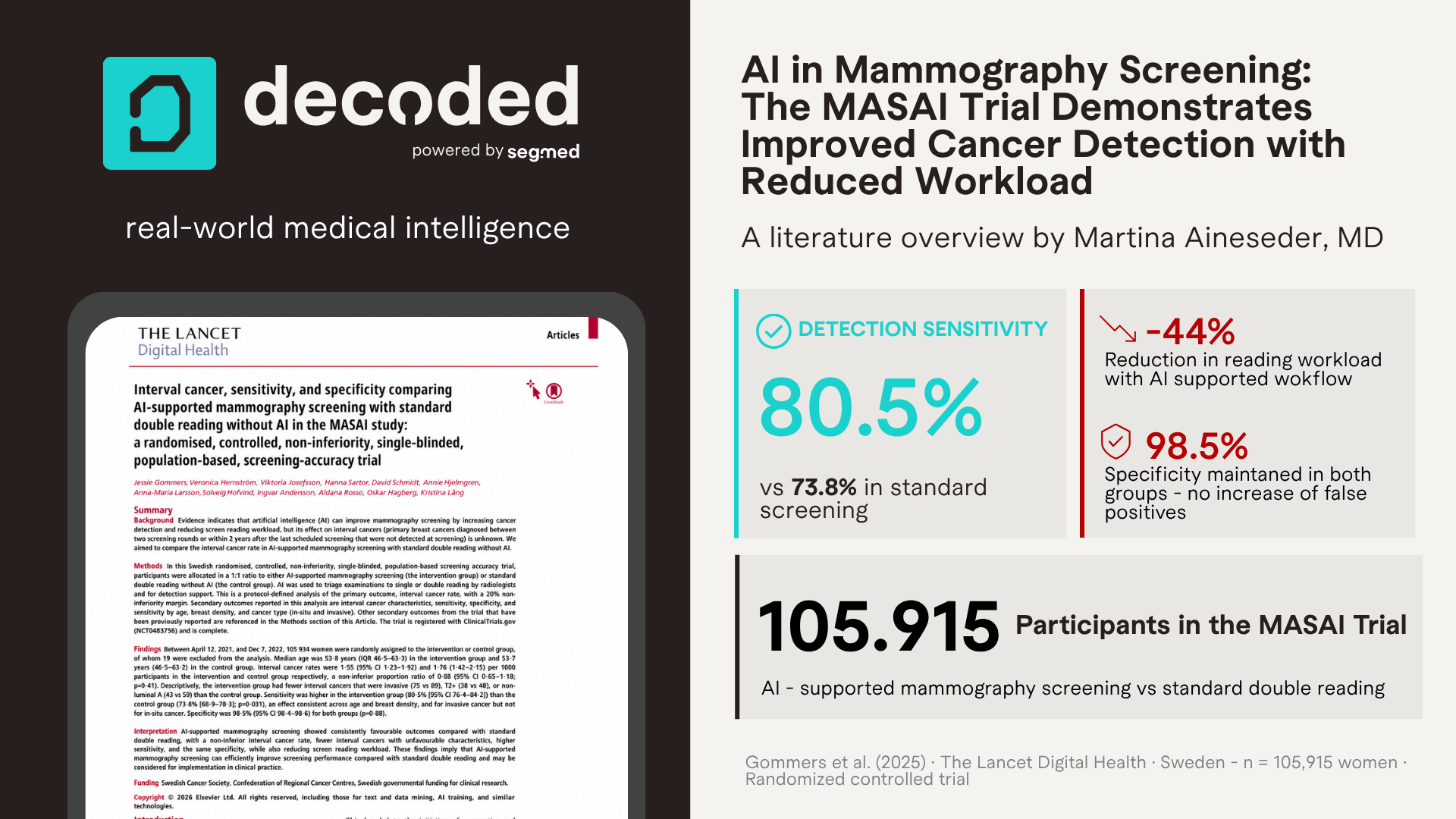
- AI-assisted screening detected cancer in 80.5% of cases versus 73.8% with standard double reading.
- Radiologist reading workload dropped by 44% without increasing false positives.
- Interval cancer rates in the AI group were non-inferior to the control group, confirming patient safety.
Introduction
Artificial intelligence continues to reshape breast imaging, and the recently published MASAI trial provides some of the strongest evidence to date supporting its role in population-based mammography screening.
Published in The Lancet, MASAI is a large randomized controlled trial conducted in Sweden that included 105,915 women. It is the first study designed not only to evaluate cancer detection performance but also to assess interval cancer rates, an essential safety endpoint that reflects cancers diagnosed between routine screening rounds.
How AI Was Integrated into the Screening Workflow
The study evaluated an AI-supported screening strategy using the Transpara system. Rather than replacing radiologists, the AI functioned as a decision-support and workflow optimization tool.
First, the algorithm assigned each mammogram a risk score ranging from 1 to 10. Examinations classified as low risk were interpreted by a single radiologist, while high-risk studies underwent conventional double reading. For these higher-risk cases, the AI also provided visual markers and lesion-specific scores to highlight suspicious findings, including calcifications and soft tissue abnormalities.
Key Results
The AI-assisted screening strategy demonstrated several important advantages:
- Higher cancer detection sensitivity, reaching 80.5% compared with 73.8% in the standard double-reading group.
- Non-inferior interval cancer rates, with 1.55 interval cancers per 1,000 women in the AI arm versus 1.76 per 1,000 in the control group, meeting the study’s primary safety objective.
- A 44% reduction in radiologist reading workload, representing a substantial operational benefit for screening programs.
- Maintained specificity, which remained identical at 98.5% in both groups, indicating that improved detection was achieved without increasing false-positive findings.
- Earlier identification of clinically significant cancers, particularly small invasive tumors, lymph-node-negative cancers, and more aggressive non-luminal A subtypes.
The AI-assisted screening strategy demonstrated higher cancer detection sensitivity while maintaining specificity and reducing radiologist workload.
Study Limitations
While these results are promising, the most important limitation of the trial includes potential limited generalizability. This study was fully conducted in Sweden and it remains unclear whether the results outside of Sweden will be similar. Additionally, only one vendor was used (Transpara).
Why Researchers Care
The MASAI trial provides robust prospective evidence that AI can enhance the performance of mammography screening while preserving patient safety. Importantly, these gains were achieved alongside a marked reduction in radiologist workload, addressing one of the major challenges faced by screening programs worldwide.
As breast imaging services continue to experience increasing demand and workforce shortages, AI-supported screening workflows may offer a practical and scalable solution to improve early cancer detection without compromising quality of care.
Segmed Perspective
The MASAI trial highlights the growing importance of high-quality imaging datasets in validating and deploying AI solutions within clinical workflows. As AI adoption expands across breast imaging and other radiology applications, access to diverse, well-curated real-world imaging data becomes increasingly important for model development, validation, and performance monitoring.
Frequented Asked Questions - F.A.Q.
What is the MASAI trial?
The MASAI trial is a large randomized controlled study conducted in Sweden that evaluated AI-assisted mammography screening in 105,915 women.
What AI system was used in the MASAI trial?
The study evaluated the Transpara AI system as a decision-support and workflow optimization tool for mammography screening.
Did AI replace radiologists in the MASAI trial?
No. The AI functioned as a decision-support tool and helped optimize workflow while radiologists remained responsible for image interpretation.
Did AI improve cancer detection?
Yes. Cancer detection sensitivity reached 80.5% in the AI-assisted group compared with 73.8% in the standard double-reading group.
Did AI increase false-positive findings?
No. Specificity remained identical at 98.5% in both study groups.
How much workload reduction was achieved?
The AI-assisted workflow reduced radiologist reading workload by 44%.
Reference
- Hernström V, Josefsson V, Sartor H, Schmidt D, Larsson AM, Hofvind S, et al. Screening performance and characteristics of breast cancer detected in the Mammography Screening with Artificial Intelligence trial (MASAI): a randomised, controlled, parallel-group, non-inferiority, single-blinded, screening accuracy study. Lancet Digital Health [Internet]. 2025 [cited 2026 Jun 24]. Available from: https://segmed.ai/solutions/rwid-multimodal
Related Resources
Real-world imaging data in oncology: paving the way for breakthroughs in breast cancer treatment
Transforming breast cancer screening: how AI and real-world imaging data enable earlier detection
Accelerating oncology research: unlocking the power of AI and real-world imaging data